Totem, a data-tracking experiment
A media-literacy experiment: a fake personality quiz, full of the web’s everyday traps, that reveals at the end everything a simple web page captured and guessed about you in two minutes. In French, German and English. The game’s data never leave your device.
An experiment. A personal trial, made to learn. It has no value beyond that of a test: it may contain errors, change or disappear, and it is neither a product nor a service of HEP-VS.
To experience the surprise, play before reading on: the rest of this page gives the trick away. The game is available in French, German and English. It follows your browser’s language, and you can switch at any time.
The idea
I work on digital education and media literacy, notably with future teachers. Saying that a website collects data is easy; making people feel it is much harder. Two projects made me want to try: clickclickclick.click, by the studio Moniker, which comments out loud on every move you make in your browser, and CheeseMaster, the game DNA Studios made for the Swiss broadcaster SRG SSR’s Dataland show, which collected data on players under the pretence of producing cheese. I wanted a short format anyone can play, combining both, that I could use in class and in teacher training.
The result
Totem looks like a viral personality quiz, “Which totem animal are you?”: seven mini-challenges, two minutes, a totem at the end. The questions are deliberately absurd (pineapple on pizza, which way the toilet roll hangs, your dream superpower) and nothing personal is asked. Meanwhile, the page records everything it can and slips in the traps we all come across on the web every day. Then it switches to an advertising “back office” that shows the file built on the player.
What it does
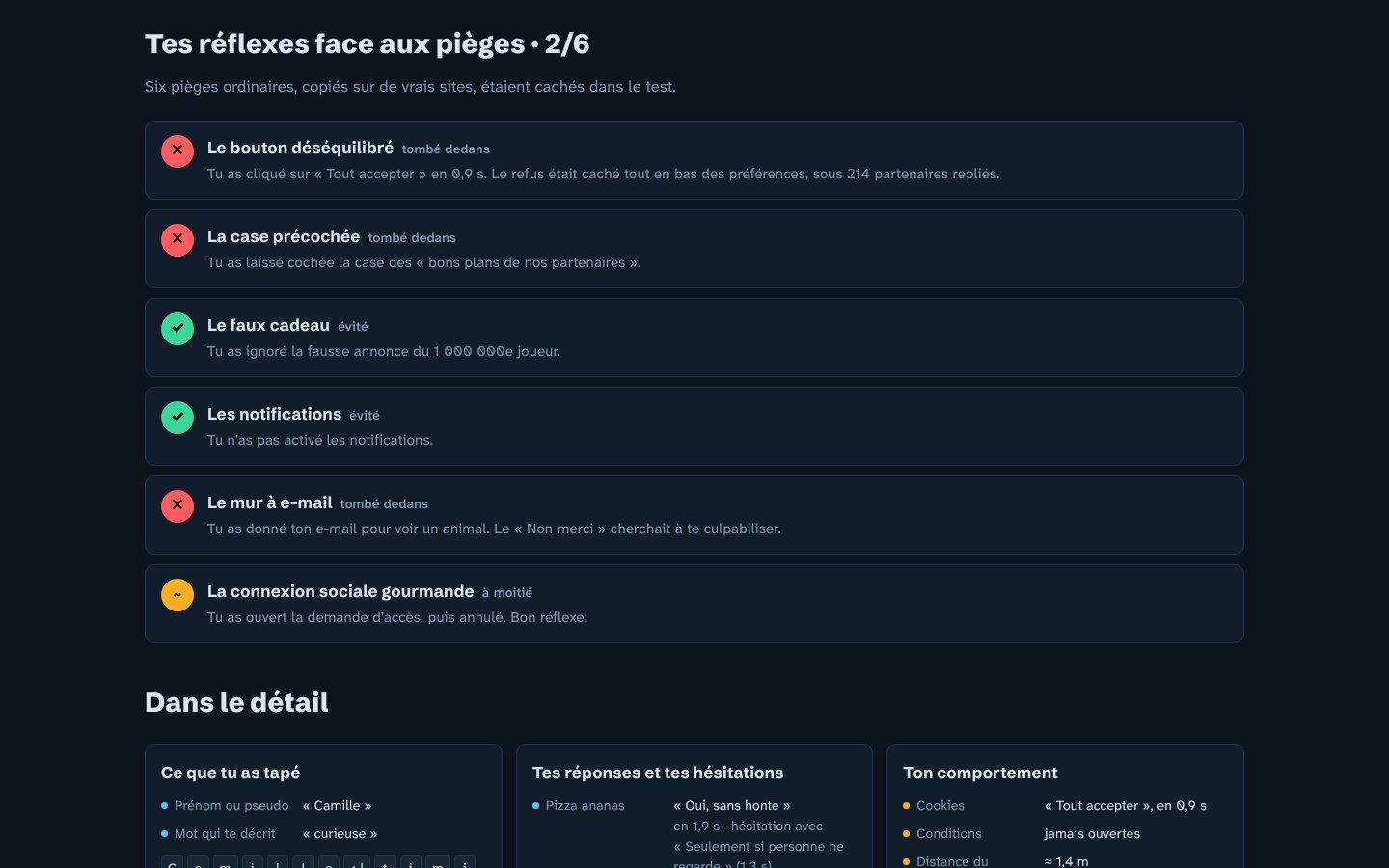
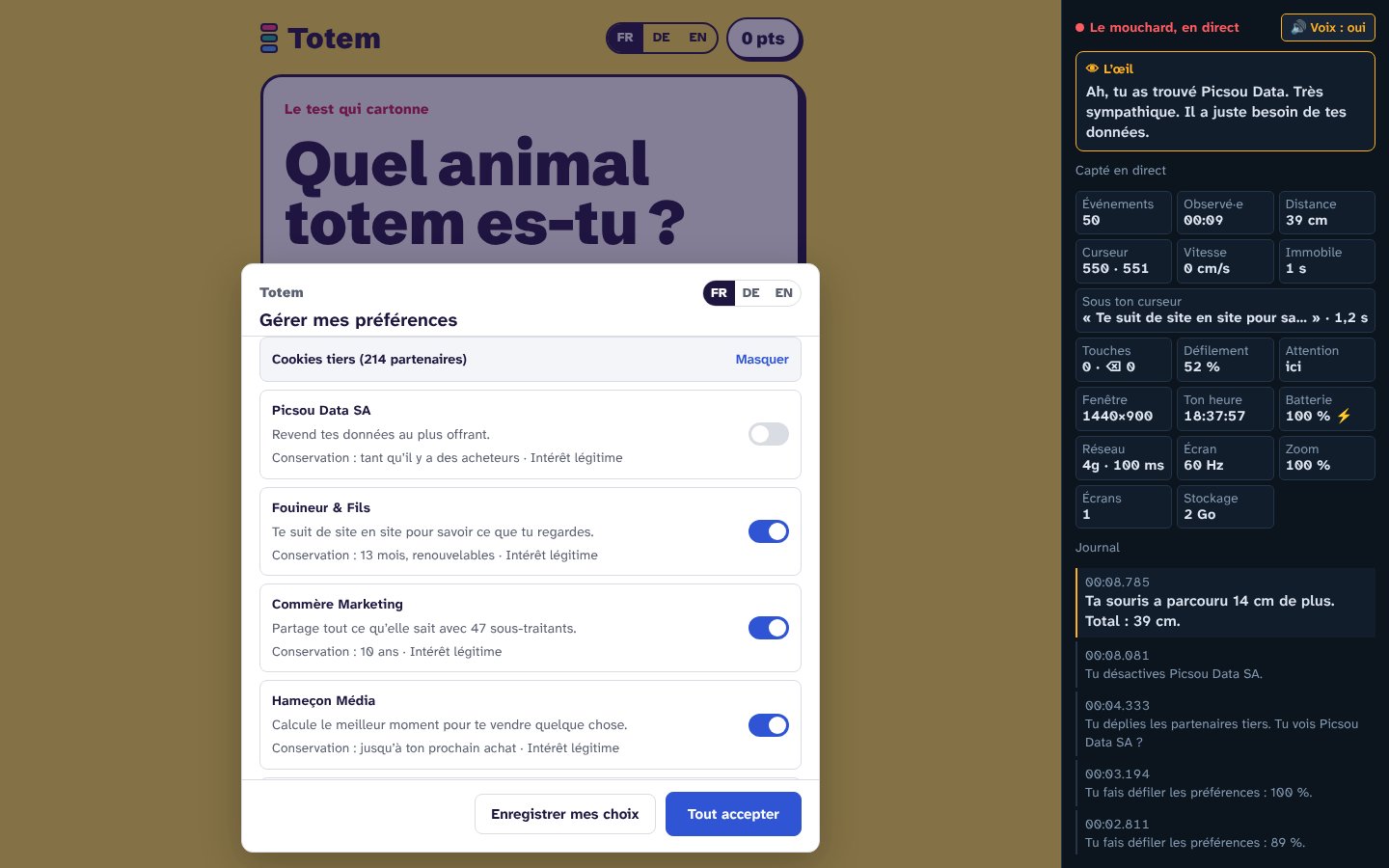
- Setting six traps copied from real websites. An ordinary-looking cookie banner where “Accept all” jumps out while rejecting is hidden at the very bottom of the preferences, below 214 folded third-party partners with telling names: Scrooge Data Ltd “sells your data to the highest bidder”, Snoop & Sons follows you from site to site, Easy Credit Express targets tired people. Then a pre-ticked box for “deals from our partners”, a fake “You are player number 1,000,000” ad, a request to turn on notifications, a wall that demands an email with a guilt-tripping “No thanks, I don’t like nice surprises”, and a login through a made-up social network that asks for the friends list and private messages. The traps neither earn nor cost points: they pass for ordinary parts of the site.
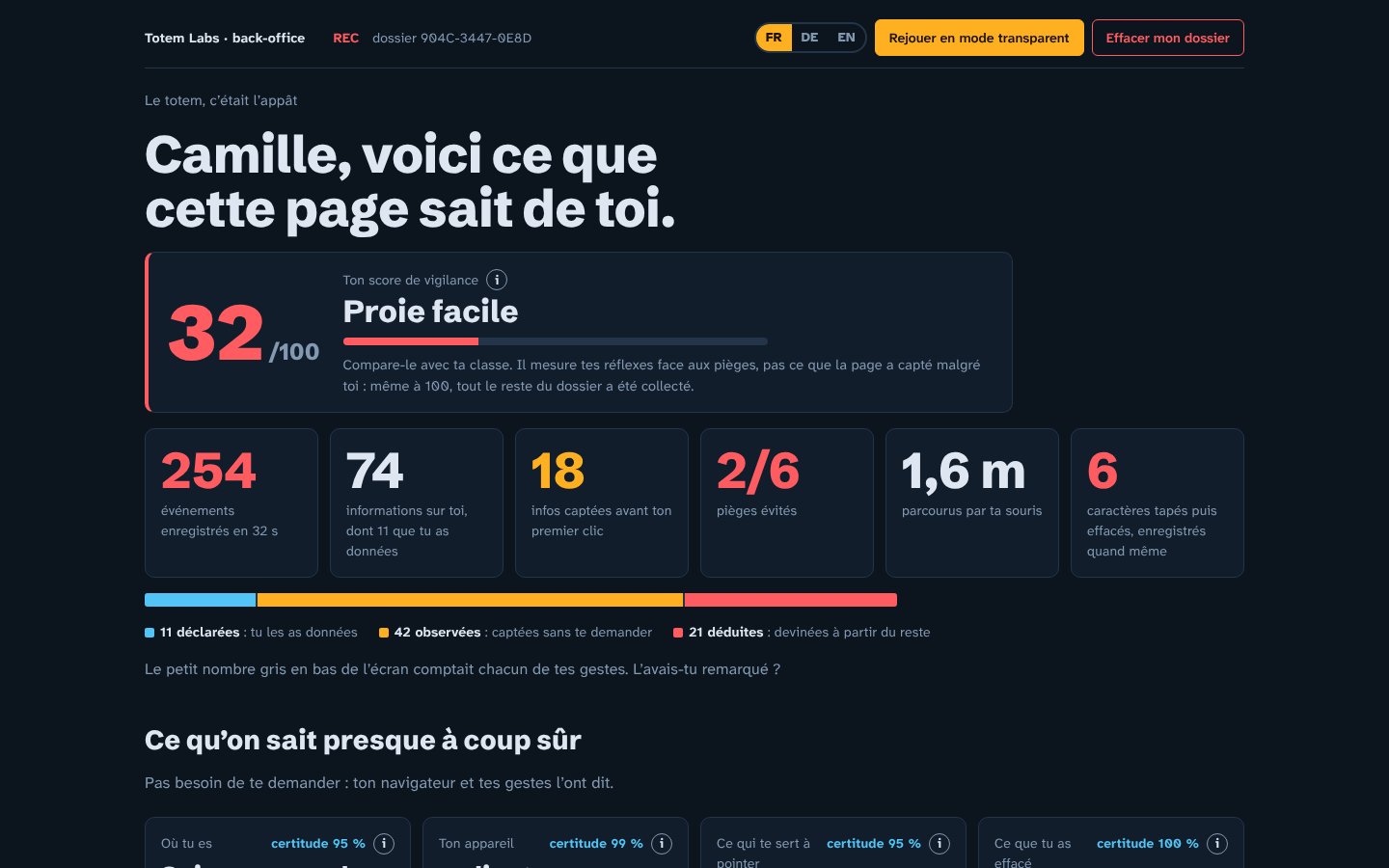
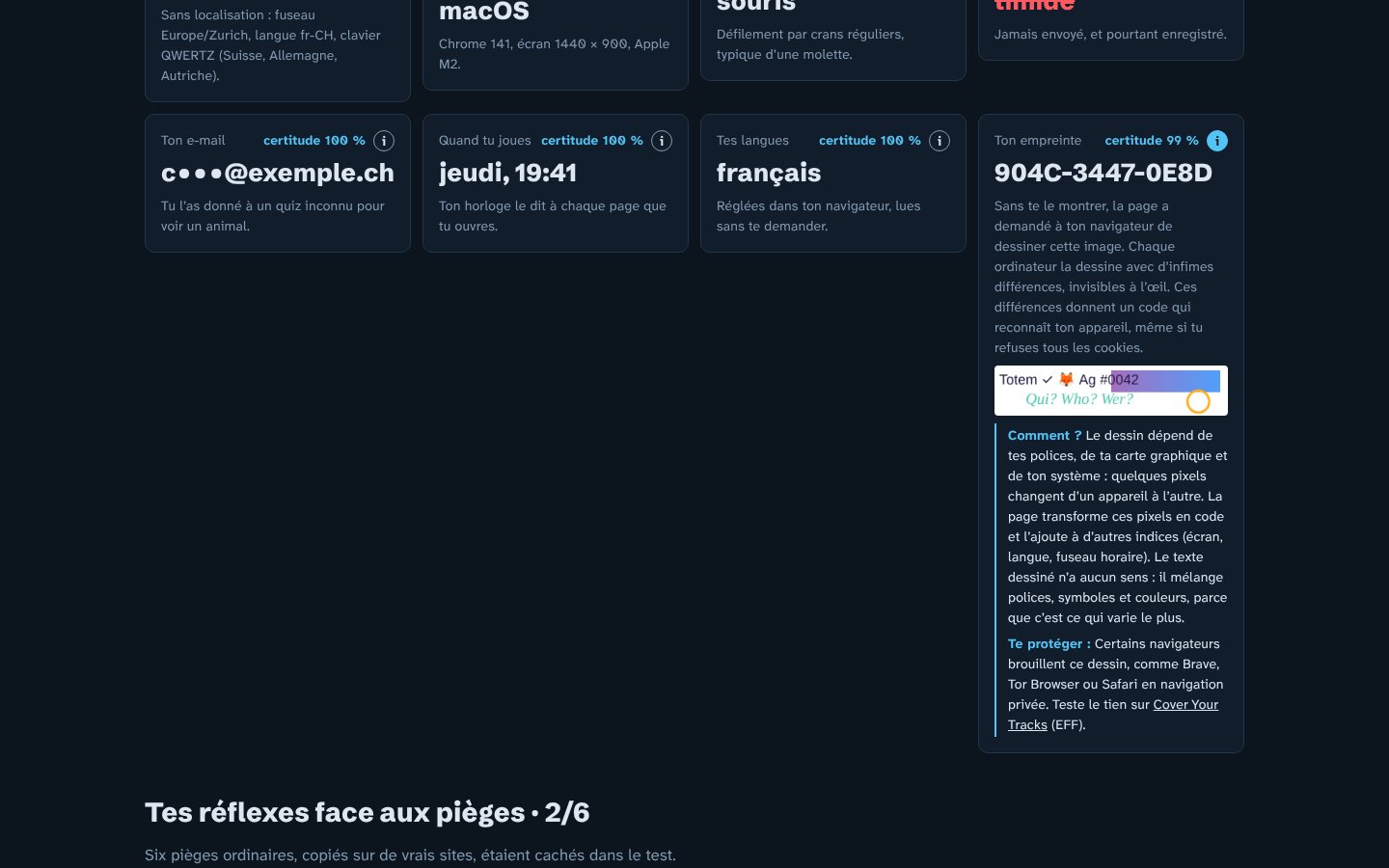
- Going from shock to detail. The file opens with an alertness score out of 100, to compare in class, then big numbers (events recorded, information captured before the first click, traps avoided, characters typed then deleted), then what the page knows almost for sure, with a level of certainty: region, device, word deleted before submitting, email, time, languages, browser fingerprint. Then come the results of the six traps, followed by the details of answers, hesitations, behaviour and device.
- Explaining each capture. An “i” button next to each technical item explains in a few lines how the page obtained it and, where possible, how to protect yourself. For the browser fingerprint, for instance: the page secretly has a small image drawn, and the tiny differences from one computer to another are enough to recognise the device without cookies.
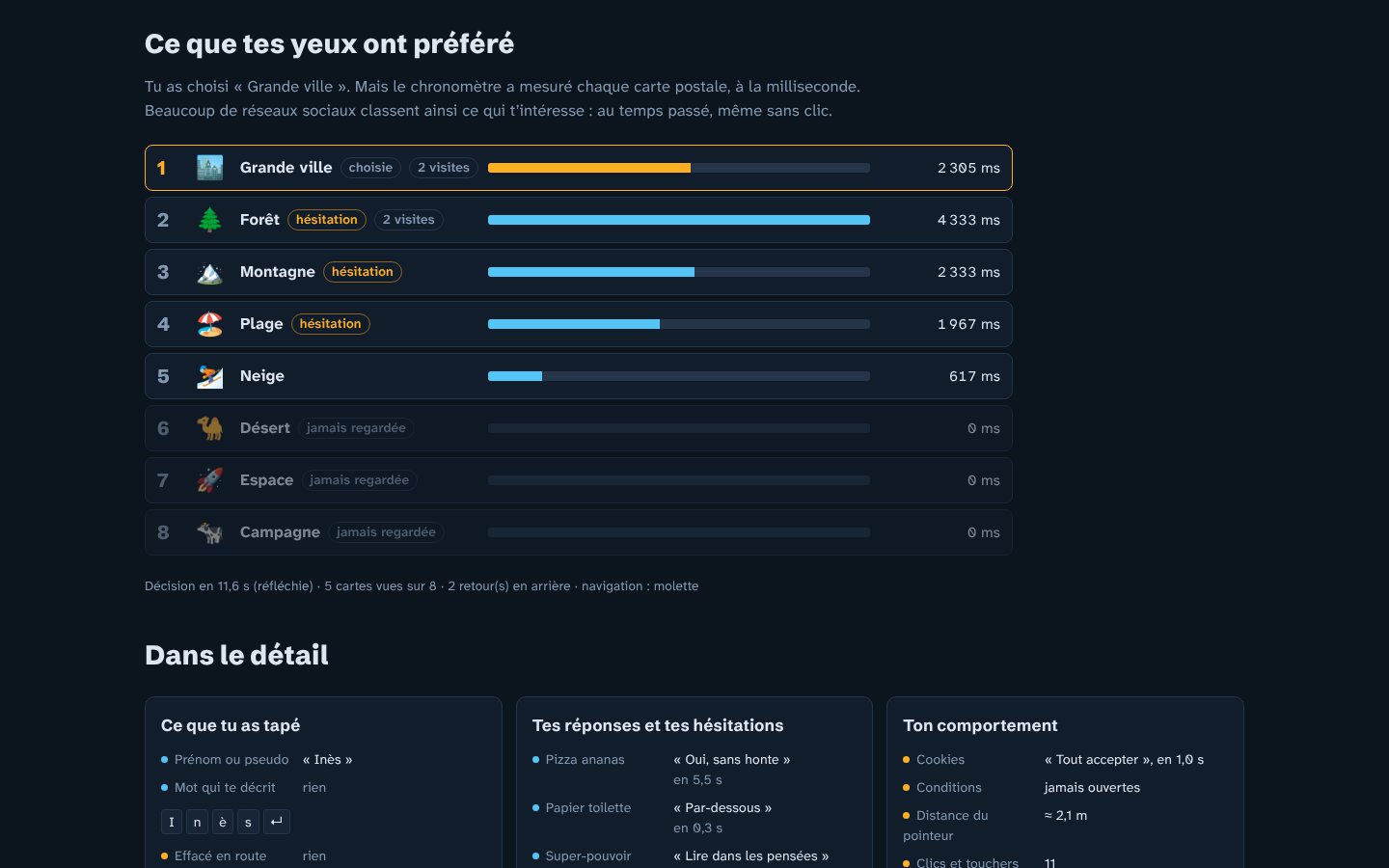
- Measuring attention, to the millisecond. One challenge asks players to scroll through eight postcards to choose where the totem goes on holiday. The stopwatch measures the time spent on each image, going back and decision speed, then infers a ranking of preferences (first, second, third choice), even when it contradicts the declared choice. The way people scroll also gives away what they use (mouse wheel, trackpad or finger), and the tilt of horizontal gestures is used to guess the dominant hand, with a level of certainty that recalls that nine people out of ten are right-handed.
- Telling given, observed and inferred apart. Each piece of information is sorted into three colours: what the player wrote or chose, what the page captured without asking, and what it drew from it. The gap between the three is the heart of the experiment.
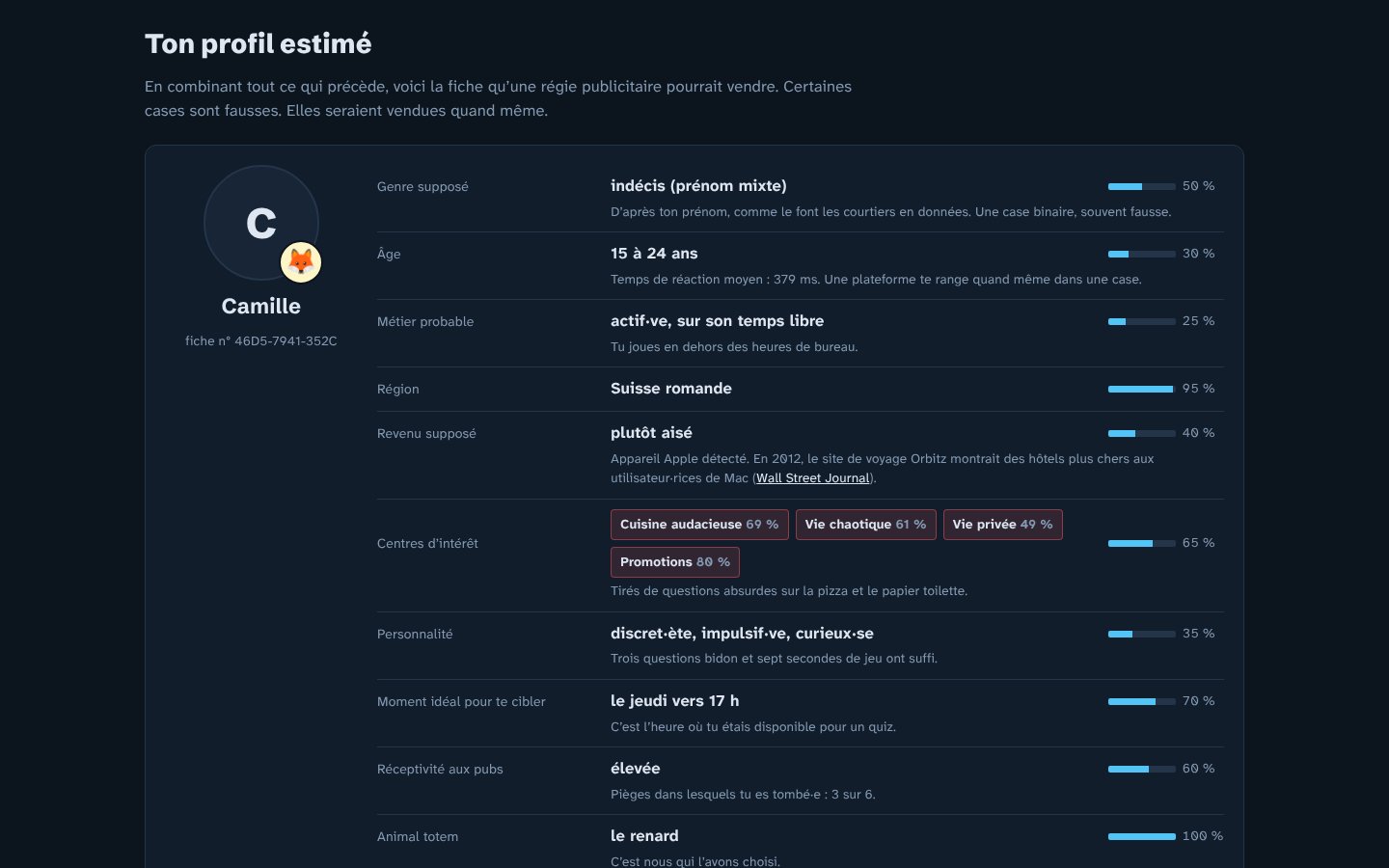
- Drawing up an estimated profile, funny and unsettling. Combining everything, the game fills in the record an ad network could sell: gender assumed from the first name, age from reflexes, likely occupation from the time and device, region, assumed income (a Mac is enough to be labelled “fairly well-off”), interests drawn from pizza and toilet roll, personality, best time to target the player, ad receptiveness. Each box shows its level of certainty; some are wrong, and would be sold anyway. A simulated auction closes the record.
- Replaying in transparent mode. A panel shows live what the page captures: cursor position and speed, the element under the cursor and hesitation time, keys and deletions, attention, window size, time, battery, network, screen refresh rate and zoom, storage offered by the browser, whether there is a camera, phone tilt. It also notes urges to leave (cursor heading for the close button), nervous clicks, keyboard shortcuts and switches to another window. With the voice on, “the eye”, a sarcastic observer, comments on every move like someone who wants to collect as much data as possible. Handy on a projector.
- Grounding it in reality. The file ends with five sourced facts (Cambridge Analytica, keystroke recording on major websites, ad auctions, browser fingerprinting, the time needed to read privacy policies), five good habits and a suggested lesson outline.
Potential
In class, from about age 10, or in adult education, the game almost stands on its own: you launch it without warning, then read your file and compare alertness scores and the traps avoided. The distinction between declared, observed and inferred data gives a simple grid for analysing any app, and the traps train a very concrete habit: look for the reject option, untick, ignore, allow nothing unnecessary. A lesson outline and discussion questions are at the end of the game, in the box for teachers. To force a language, in a language class for instance, add #en, #de or #fr to the game’s link. To keep the surprise, share that link directly rather than this page.
Limits
- A single web page sees less than a real platform: no history, no contacts, no cross-site matching. The file therefore falls short of reality.
- The inferences rest on simple rules I wrote myself. They imitate the logic of profiling, not its precision. Assuming gender from a first name deliberately reproduces a data-broker practice: a binary box, often wrong.
- The dominant hand is guessed mostly from statistics (nine people out of ten are right-handed) and from a slight tilt in gestures: it is fragile, and the game says so. A touch mouse such as a Magic Mouse looks like a trackpad.
- The traps imitate common practices without targeting any particular site; the brands, the social network and the auction are made up.
- The reveal can surprise or make people uncomfortable: plan time to talk after the game.
Good to know
- Everything is computed in your browser: the game’s data are neither sent nor stored, and disappear when you close the page. No cookies. An email, if entered, is never kept in full (only the first letter and the domain remain on screen). Like every page on this site, the game page is only counted by the visit statistics described on the privacy and legal notice page.
- The game addresses players informally, like the quizzes it imitates.
- Provided as is, free of charge and without any warranty.
Co-created with Claude Opus 5.5