Oracles comparés, a critical-thinking experiment
A critical-thinking experiment: fourteen esoteric systems applied to the same births, to observe their contradictions, cognitive biases and the Barnum effect. The people you enter are never sent anywhere. Interface in French.
An experiment. A personal trial, made to learn. It has no value beyond that of a test: it may contain errors, change or disappear, and it is neither a product nor a service of HEP-VS.
The idea
I work on critical thinking and media literacy, notably with future teachers. Cognitive biases and the Barnum effect are easy to explain, but much better understood when experienced first-hand. This tool is a trial in that direction: apply fourteen esoteric systems to the same birth dates, and look at what each one claims, how they contradict each other, and why their portraits nonetheless seem accurate.
The result
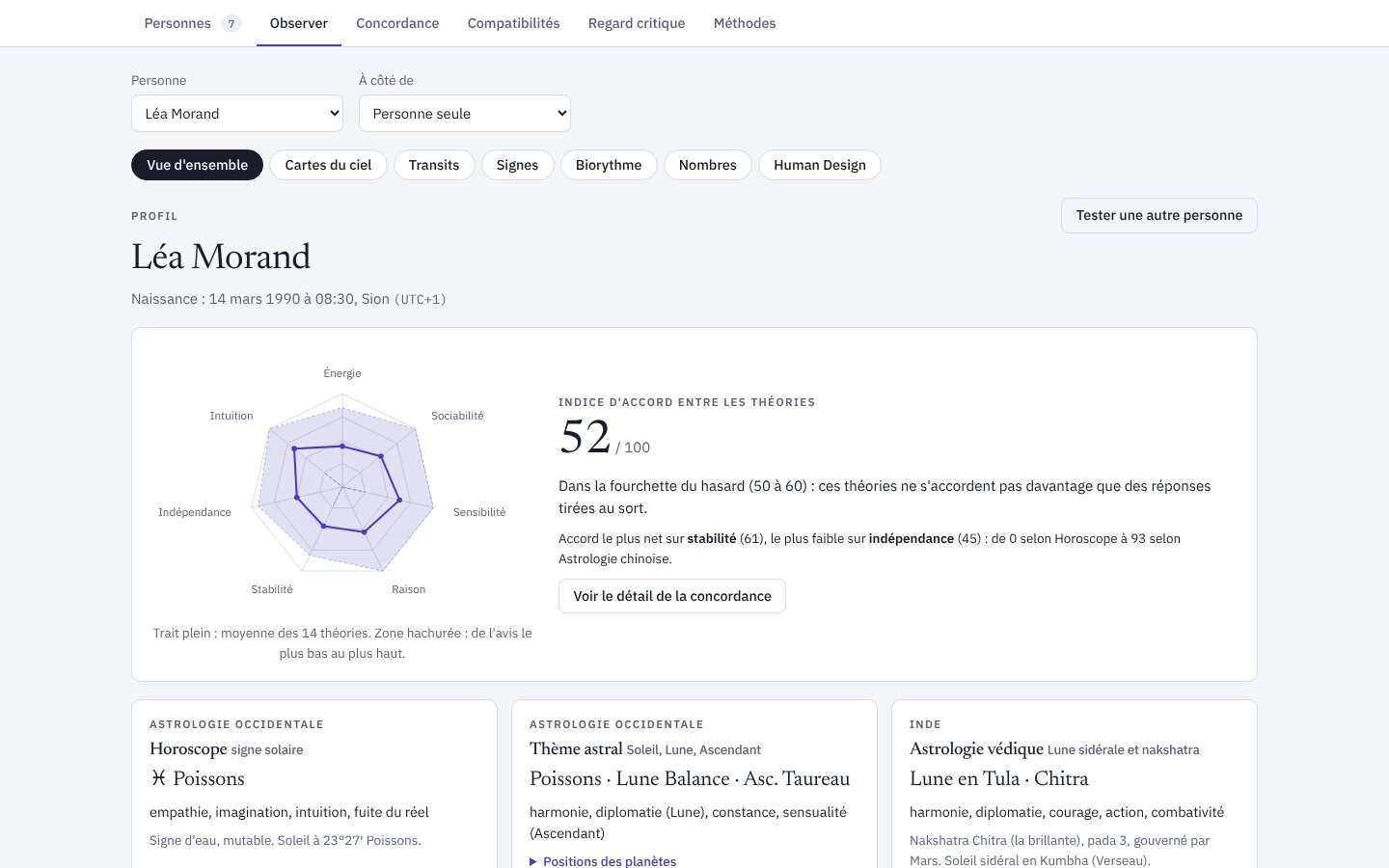
A dashboard that sets side by side the horoscope and birth chart, Vedic and Chinese astrology, Ba Zi, 9 Star Ki, numerology, tarot, the destiny matrix, the Celtic tree horoscope, Mayan kin, Human Design, moon phase and biorhythms. The interface is in French.
What it does
- What does each system say about the same person? The calculations follow the rules of each tradition (planetary positions, historical daylight saving time, Chinese solar terms, traditional tables). To allow comparison, each result is translated onto a common grid of seven traits.
- Do they agree more than chance? The tool draws thousands of random answers from each system’s tables and compares. For a group, it also measures how similar the systems are.
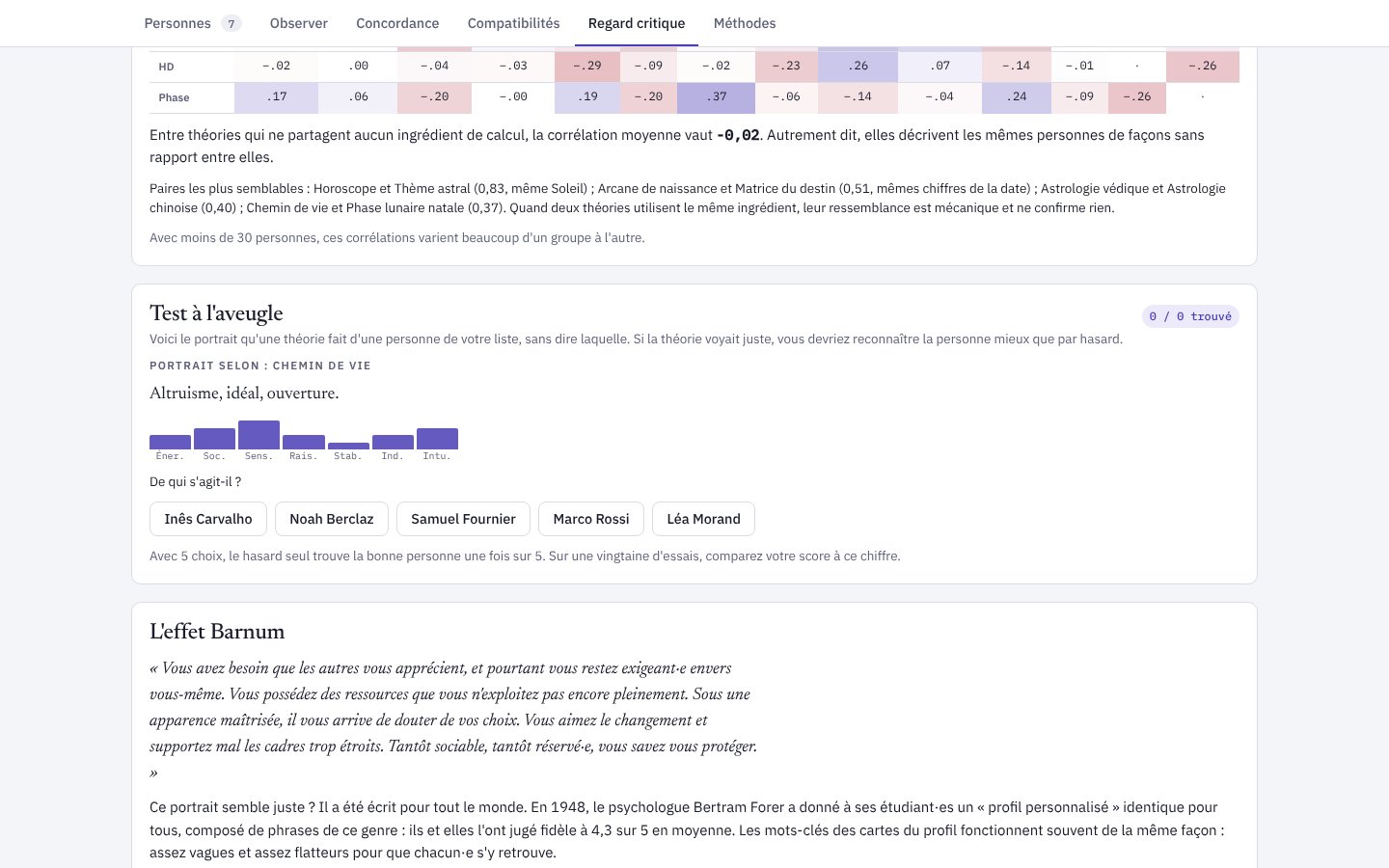
- Why do the portraits seem accurate? The critical-eye tab offers a blind test: find, among people you know, the one a system describes.
- Look in detail at one or two people: sky charts, transits, numbers, Human Design, compatibility according to ten systems.
- A briefing on biorhythms, a full case study: history, calculation, the studies that refuted it, and nine activities for class or training (in French).
Read the biorhythm briefing (PDF, 12 pages, in French)
Potential
Curves, percentages, learned vocabulary, references to real sciences: the tool gathers the devices that give content a scientific appearance. It helps tell the precision of a calculation from the validity of what it claims to measure. In class or adult education, it lends itself to short activities: comparing portraits of the same person, running the blind test, working out the share of “critical” biorhythm days expected by chance.
Limits
- Translating each tradition onto a seven-trait grid is my own choice, open to debate, which simplifies richer systems.
- The calculations aim for accuracy, but they have not been checked by specialists of each tradition.
- A blind test with a few people is not a scientific study; it is meant to prompt reflection, not to prove.
- A tool, even a critical one, can be taken at face value: it works better with guidance.
Good to know
- Everything is computed in your browser: the people you enter are neither sent nor stored. Only enter other people with their consent, or use fictitious people.
- None of the systems shown has demonstrated predictive power in controlled studies: the tool is not for making decisions or judging anyone. Nor is it meant to mock people who believe in them.
- Astronomical calculations use the astronomy-engine library (MIT licence). The IBM Plex and Newsreader fonts (SIL OFL licence) are served by this site.
- Provided as is, free of charge and without any warranty: check what the tool produces before relying on it. See also the privacy and legal notice page.