How I learn
A short questionnaire drawn from the MSLQ, to become aware of the way you learn: an immediate profile on your phone, the group’s anonymous results live, no account needed.
A prototype. A personal trial, made to learn. It has no value beyond that of a test: it may contain errors, change or disappear, and it is neither a product nor a service of HEP-VS.
Create a session Take the questionnaire for myself
The idea
In my training sessions on AI and learning, I start by raising awareness of the way we learn. This questionnaire is the starting point: what we say we do. The rest of the training shows what we actually do.
It uses four scales of the Motivated Strategies for Learning Questionnaire (MSLQ), a self-report questionnaire on learning strategies published by Paul Pintrich and colleagues in 1991, whose manual allows the scales to be used separately.
The result
A 30-item questionnaire, an immediate profile for each person, and the group’s anonymous results live.
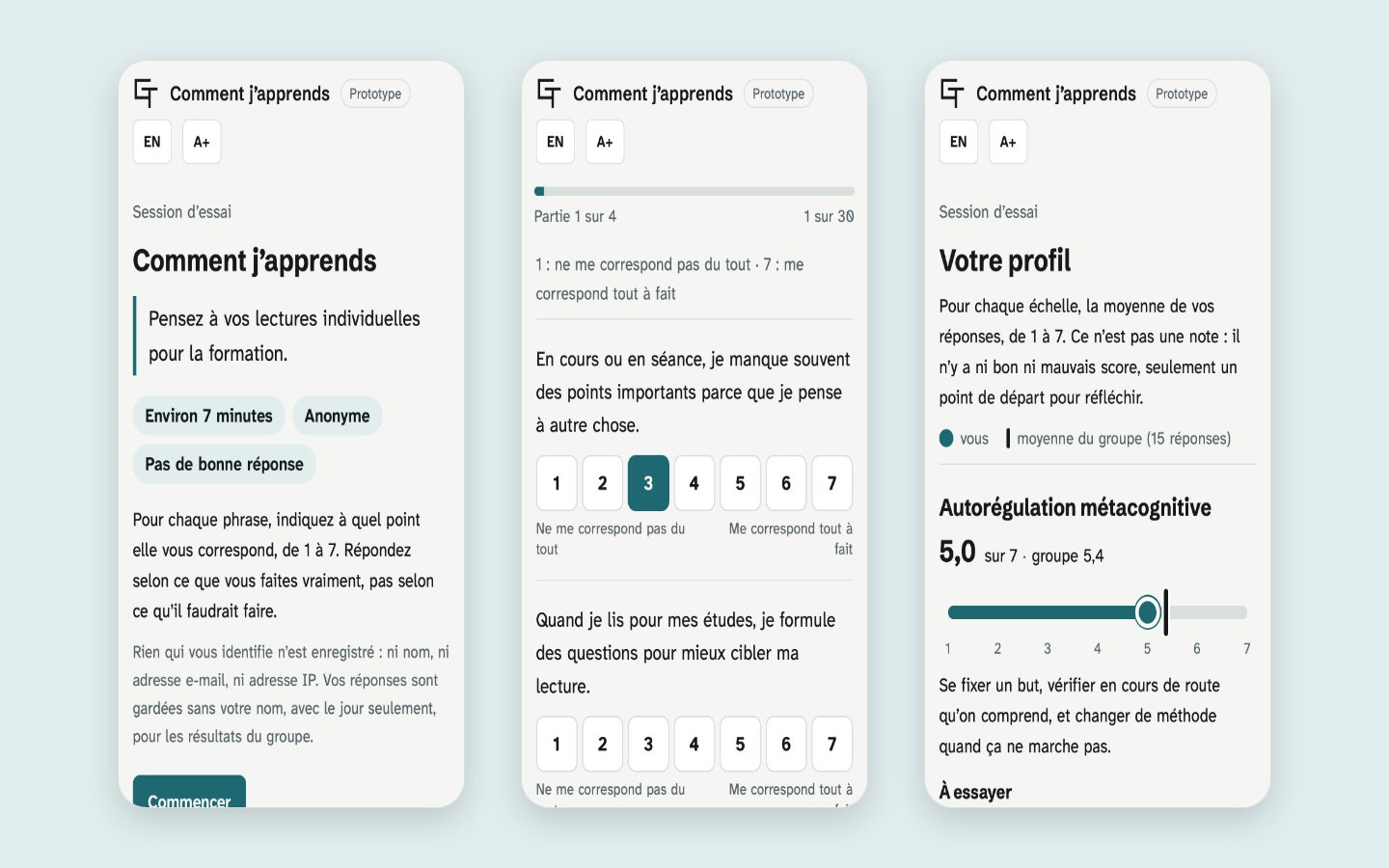
What it does
- Create a session, no account needed. A title, the scales to keep, a context sentence in French and in English (for example “Think about your individual reading at the Team Academy.”) and the questionnaire language. You get a link for participants, with a short code and a QR code to project, and a secret link for the results.
- Answer on a phone, in 6 to 8 minutes. One scale per screen, from 1 (“Not at all true of me”) to 7 (“Very true of me”).
- See your profile straight away. For each scale, your average from 1 to 7, the group’s once there are 5 answers, what the scale means and two things to try. The profile can be kept in the browser, to compare later, or downloaded as an image.
- Follow the group live. The results page updates every 10 seconds: number of answers, group average and spread of individual averages for each scale. A projection mode shows it large. The session can be closed, reopened, exported as an anonymous CSV file or deleted.
- Take it for yourself. The “Take the questionnaire for myself” button offers the same questionnaire without a session: nothing is sent.
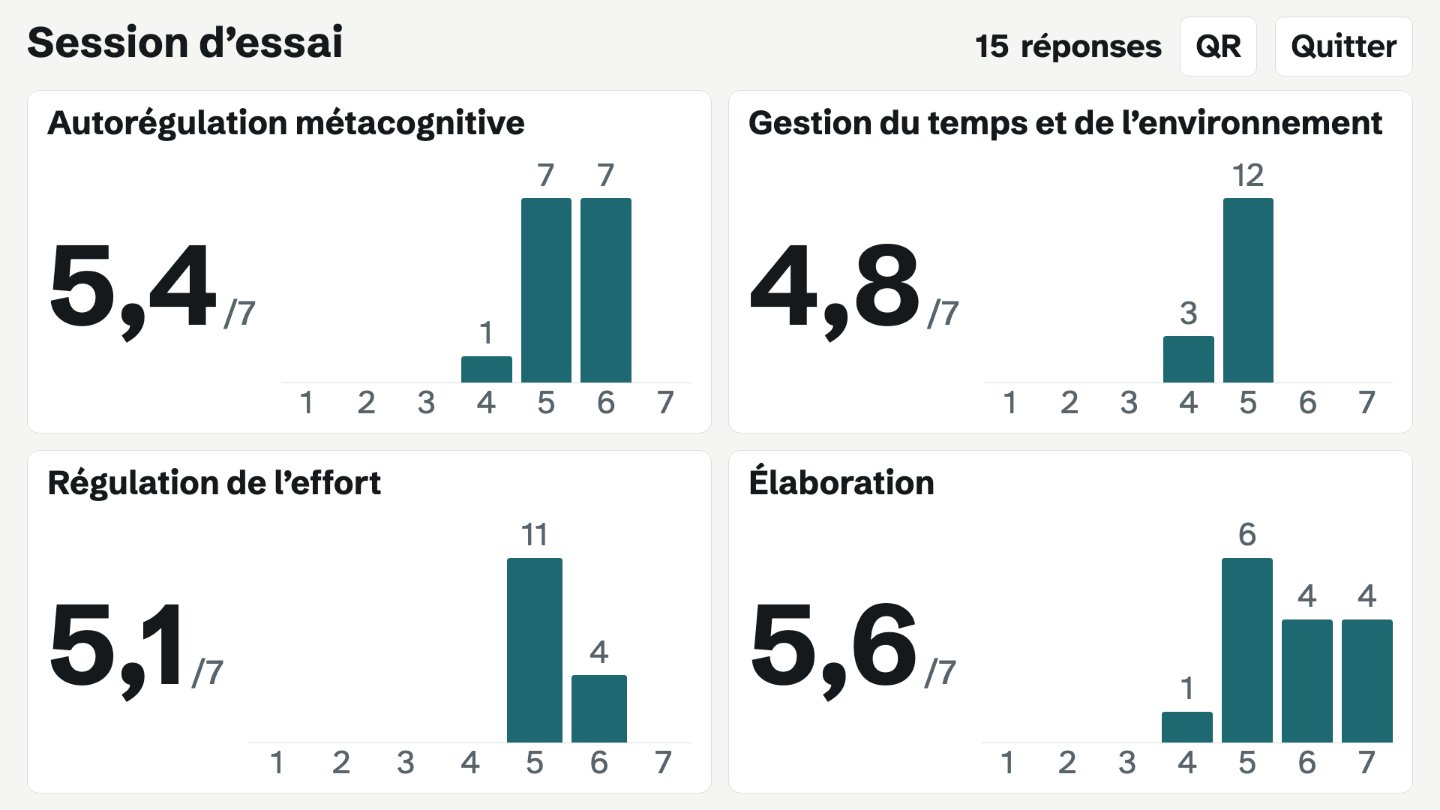
The four scales
| Scale | Items | What it describes |
|---|---|---|
| Metacognitive self-regulation | 12 | Setting yourself a goal, checking along the way that you understand, and changing method when it isn’t working. |
| Time and study environment | 8 | Organising when and where you study, and sticking to it. |
| Effort regulation | 4 | Keeping going when it is difficult or boring. |
| Elaboration | 6 | Linking what you learn to what you already know, rephrasing it, applying it. |
Some items are worded the other way round, for example “I find it hard to stick to a study schedule”: their answer is reversed (8 minus the answer) before the scale average is calculated.
Its limits
- It is not a validated version. The full MSLQ has 81 items and 15 scales. Here, only four scales, adapted (“this class” becomes “my studies”) and translated into French as a working translation, not validated. The session’s context sentence says what the items refer to.
- It does not measure what people do. A questionnaire measures what people say they do. Pintrich himself notes that such questionnaires are not very good at capturing the actual processes of self-regulation (Pintrich, 2004, p. 401).
- There are no norms. No “good” or “bad” threshold: the tool shows the person’s average, and the group’s. It is a tool for reflection, not a diagnosis.
Sources
- Pintrich, P. R., Smith, D. A. F., Garcia, T., & McKeachie, W. J. (1991). A manual for the use of the Motivated Strategies for Learning Questionnaire (MSLQ). University of Michigan. https://eric.ed.gov/?id=ED338122
- Pintrich, P. R. (2004). A conceptual framework for assessing motivation and self-regulated learning in college students. Educational Psychology Review, 16(4), 385-407. https://doi.org/10.1007/s10648-004-0006-x
Good to know
- What is recorded. For a session: its title, scales, context sentences, language, the day it was created and a fingerprint of the results key (never the key itself). For each answer: the item answers, the scores and the day. No name, no email address, no IP address, no browser fingerprint, no time.
- Who sees what. The results only open with the session’s secret link. The person who created it can close the session, export the anonymous answers and delete everything. Sessions older than one year are deleted with their answers.
- The “for myself” mode sends nothing. “Keep my profile” stores the profile in your browser only.
- The QR code is produced by the qrcode-generator library (MIT licence), served by this site like the fonts: no request to any other service.
- Provided as is, free of charge and without any warranty. See also the Privacy and legal notice page.