Atlas of foreign interference
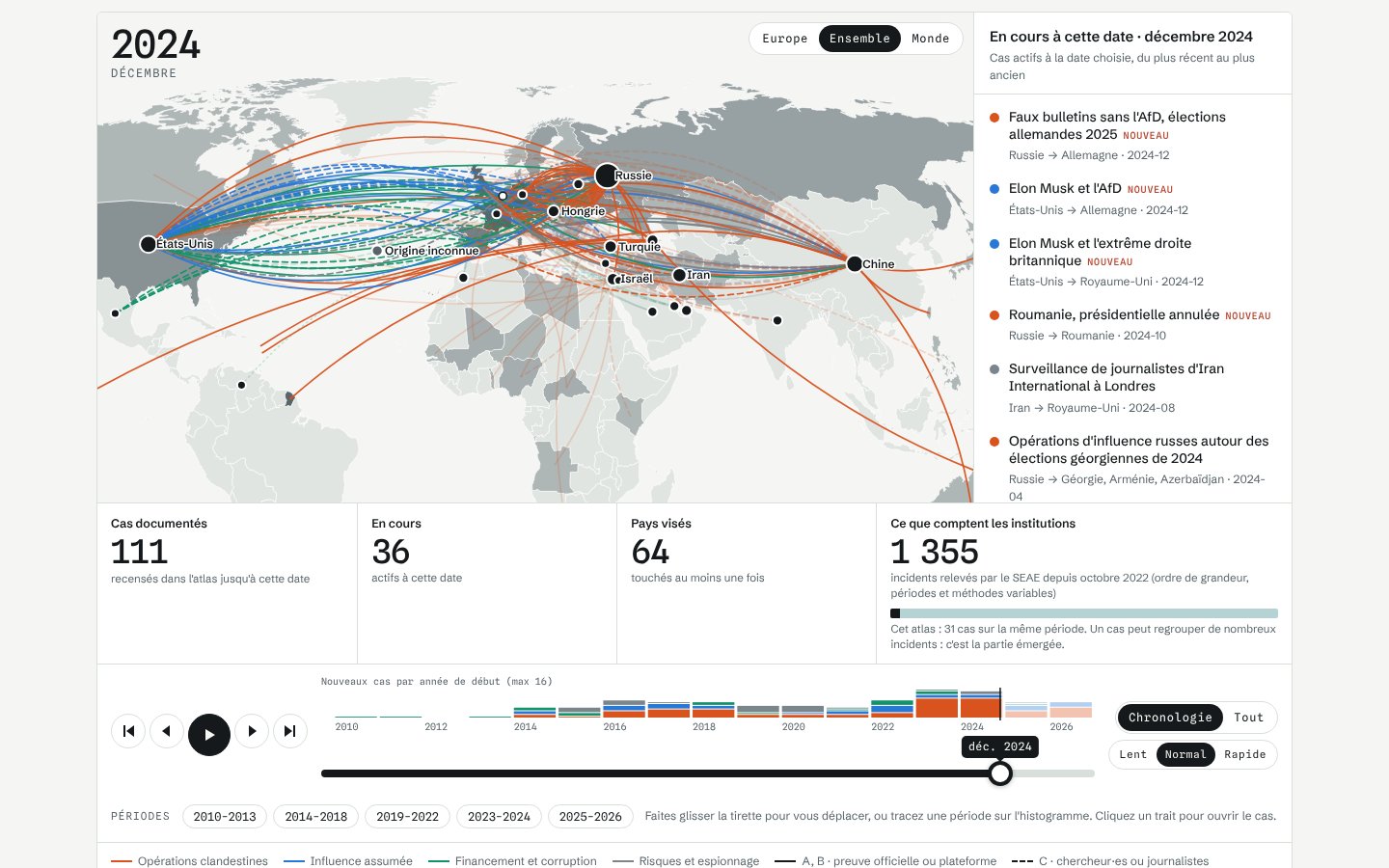
An animated map of disinformation, interference and foreign influence campaigns targeting Europe since 2010: 129 documented cases, each with its case file, level of evidence and sources.
Working file. This atlas is an experiment, built to explore what can be done today with AI and open sources. It is not an official census: it may change and contain errors. Each case file links to its sources so that you can check.
Open the atlas See the sources
What it is
We hear about disinformation campaigns one at a time: a fake video here, a network of fake accounts there, a loan to a party, a report that comes out and is soon forgotten. This atlas puts them side by side, in time and space, to see the pattern: who acts, against whom, by what means, to whose benefit, and what we actually know about the effect.
It gathers 129 cases targeting Europe from 2010 to 2026, Switzerland included: covert operations (fake outlets, fake accounts, deepfakes), espionage and repression of diasporas, bribery of elected officials, party funding, but also open and legal influence, such as Elon Musk's public interventions or a foreign government's funding programmes. These forms of influence are not equivalent, and the atlas does not conflate them: each has its own colour and category. It shows them together because official reports on foreign interference only count the covert part.
What you can do
- Go back in time: press play, or drag the slider to move forward and back month by month. The speed can be adjusted, and the arrows move one month at a time.
- Choose a period: one button per main period (2014-2018, 2019-2022…), or draw your own period on the histogram. The map, the list and the counters then show only the cases active during those months.
- Get the scale: the counters rise over time (documented cases, ongoing cases, targeted countries). The last one is a reminder of what the atlas does not show: the European Union's diplomatic service alone logs hundreds of incidents a year.
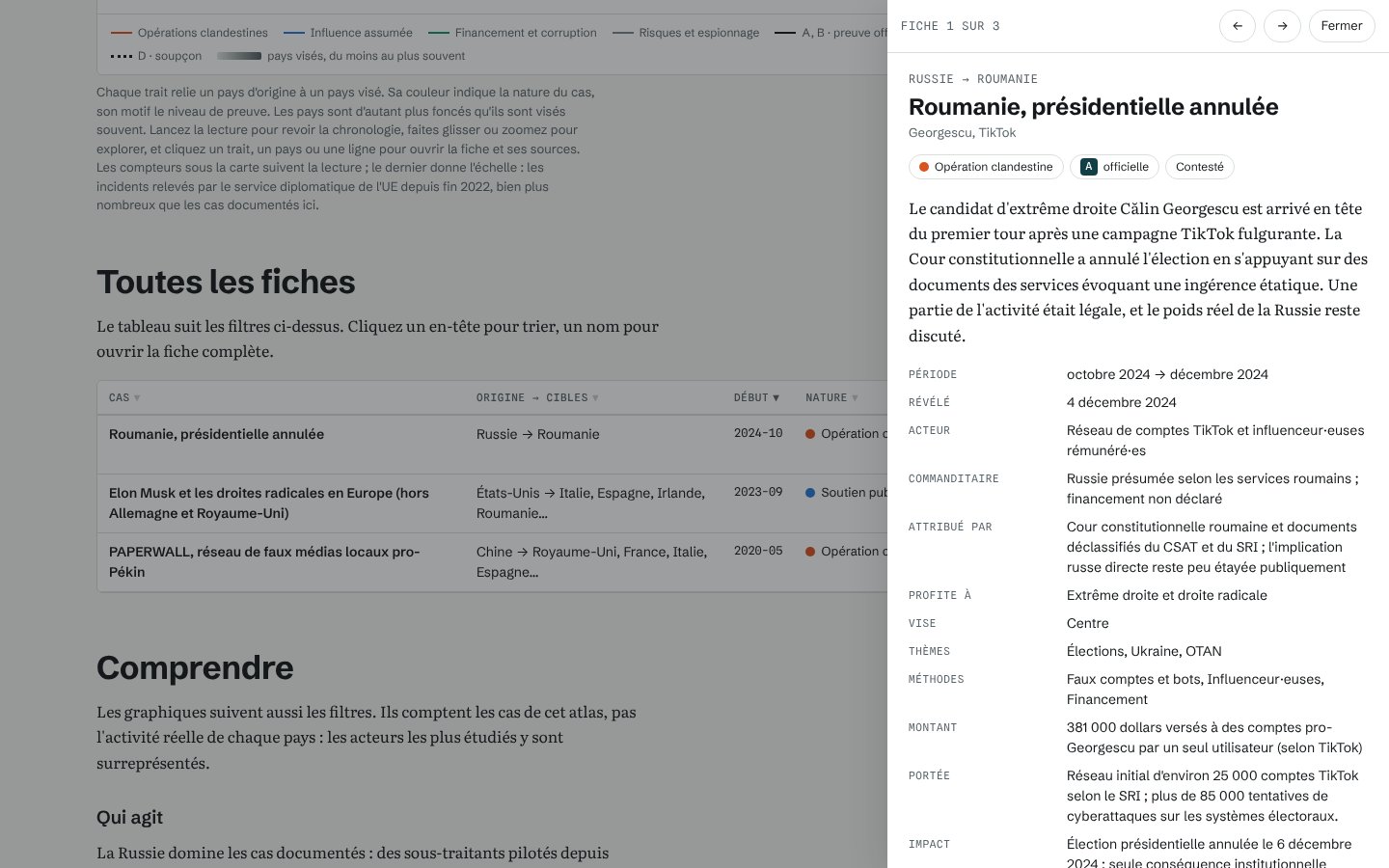
- Open a case file: click a line, a country or a row. Each file gives the period, the actors, the presumed sponsor, who attributed the operation, the reach, the impact, the response and the sources. The arrows move from one file to the next.
- Filter and search: by origin, by side favoured, by theme, by nature of the case, by level of evidence, or by name.
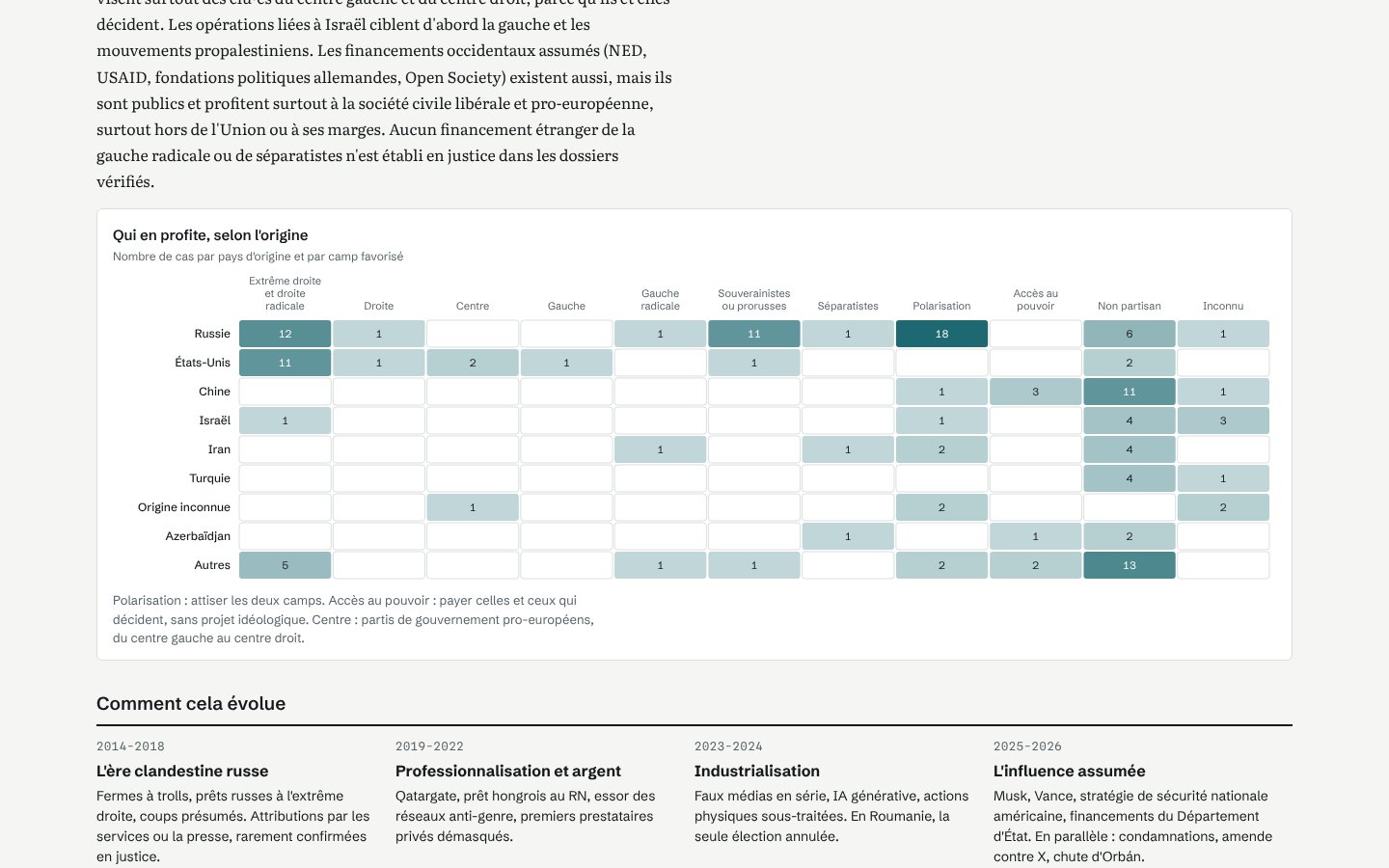
- Make sense of it: charts and short texts on who acts, who benefits, how it evolves, what is measured and what escapes measurement.
Method
Which cases. A case enters the atlas if it targets a European country or the EU institutions, if it is publicly documented by at least two reliable sources, and if it involves a foreign actor, real or presumed. Sources are agency reports (Viginum in France, the EU's diplomatic service, intelligence services), court rulings and sanctions, platform reports (Meta, OpenAI, Microsoft, Google), research centres (DFRLab, ISD, Citizen Lab, EU DisinfoLab) and major press investigations.
What is recorded for each case. The nature (covert operation, declared influence, funding, bribery, public support, espionage, risk), the country of origin and the targeted countries, the dates, the operating actor and the presumed sponsor, the political side favoured and the side targeted, the methods, the reach, the known impact, the authorities' response and the status of the case.
Levels of evidence. A: official attribution (a state, the European Union, a court ruling, a sanction). B: attribution by a platform. C: researchers or journalists. D: unconfirmed suspicion, or a theory rejected in court. The level refers to the attributed origin, not just to the deceptive behaviour. A "pro-Russian" campaign that has been spotted is not necessarily ordered by Moscow: each file says who claims what, and whether the sponsor remains unknown.
Checking. The case files were written from the cited sources, then part of them was checked again independently, especially those naming people in cases not yet tried and the most recent facts. Institutional figures (EEAS, Meta, ISD, Viginum) are shown separately: they are not measured the same way and do not add up with the atlas cases.
The source catalogue. A separate catalogue gathers 506 reports and documents: annual reports by European and Swiss intelligence services, government and parliamentary reports, court rulings and sanctions, reports by European institutions, platforms and research centres, academic studies and archives. It starts from the sources rather than the conclusions and seeks to cover every country of origin named and every political side: it includes declared and legal influence (American or European funding, for example) and contested allegations, including against the United States or the European Union, flagged as such. Each document is described, with its attribution level and a link to read or download it: browse the source catalogue.
Limits
- One only finds what one looks for. Institutions and researchers mainly watch Russia and China; Türkiye, the Gulf states, India, Israel and the United States are less studied. The most watched actors are therefore over-represented.
- Most of it is never detected. There is no reliable estimate of what goes unnoticed. Messaging apps, Telegram, TikTok and forums are poorly covered, and access to platform data is shrinking.
- Reach is not effect. Millions of views do not tell whether opinions or votes changed. Available studies usually find a weak effect or one that cannot be isolated, which does not mean none: repetition and the exploitation of existing divides work over time.
- Coding a political orientation is a judgement. Saying that an operation "benefits" a side often sums up a logic that is more geopolitical than partisan; the case files explain the choice.
- A snapshot. The database stops on 21 October 2026. Ongoing cases may end differently, and people implicated in cases not yet tried are presumed innocent.
- Work done with AI. The research and writing were carried out with the help of Claude, from open sources, then reviewed. Errors remain possible: the rule is always to go back to the source.
For media literacy
Who it is for. Lower and upper secondary teachers who deal with information, propaganda or democratic life; teacher educators; students of journalism, political science or communication; libraries, and anyone who wants to form their own view. In French-speaking Switzerland, the atlas can support the Media strand of digital education in the Plan d'études romand.
What it helps to practise. The atlas does not say what to think: it provides real cases, their sources and their degree of certainty, to exercise judgement. A few ideas:
- Reading an attribution. Compare a level A case and a level C case on the same theme. Who claims what? Rephrase each claim with the appropriate caution ("according to Viginum", "alleged", "not established").
- Going back to the source. Pick a case file, open its sources, check that they say what the file summarises, and look for a third, independent source.
- Reach or effect? Take a case with several million views and ask what we actually know about its effect, and how it could be measured.
- Two vocabularies. Compare a covert operation and a case of open influence. Why do we speak of interference in one case and of lobbying or diplomacy in the other? Where should the line be drawn?
- A fabricated image. Start from the AI-generated image of an elderly couple after the 17 October 2026 protests: trace its spread, identify who amplified it, and see why no attribution is possible.
- What is missing. List what the atlas cannot show and formulate hypotheses about what escapes detection, without presenting them as facts.
Points of care. The subject lends itself to conspiracy readings: a detected campaign does not prove that an election was rigged, and a state that runs operations is not its population. It is worth keeping the same standard of evidence for every country and every political side, and distinguishing what is established from what is suspected.